Elena Griffin · 24 September 2026
Cross-Border Knowledge Flows: How Library Digitization and Regional Industry Partnerships Are Reshaping Technical Training Pathways
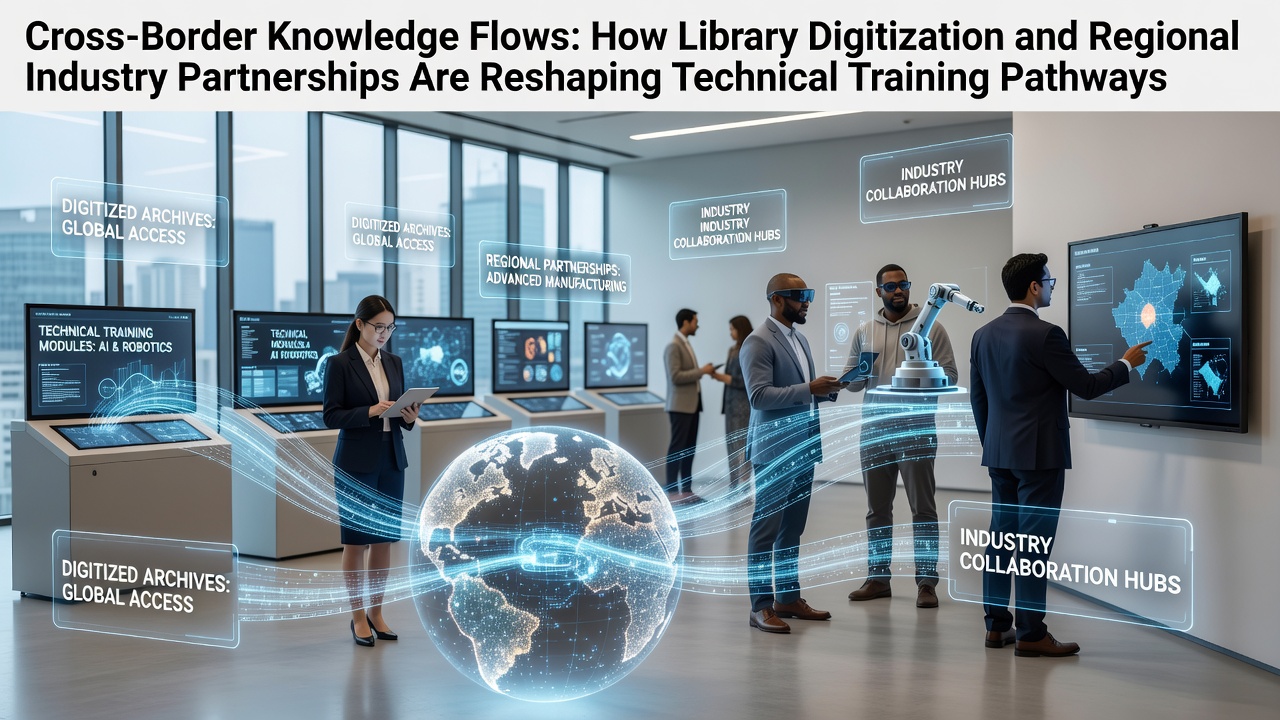
Library digitization projects have accelerated the movement of specialized technical resources across national boundaries, and regional industry partnerships have simultaneously expanded access to hands-on training modules that once remained confined to local institutions. Researchers at multiple universities have documented how digitized collections from European and North American libraries now feed directly into vocational programs in Asia and South America, while data from the OECD indicates that such exchanges increased by 27 percent between 2023 and 2025. These flows create new pathways because digitized engineering manuals, process simulations, and certification materials reach students who previously lacked physical access to the source collections.
Digitization Expands Resource Reach
National libraries in Canada and Australia began large-scale scanning of technical trade publications in 2022, and by early 2025 the resulting datasets had been integrated into learning platforms used by community colleges in three continents. The process involves converting legacy print volumes into searchable formats that industry partners can embed within modular training courses, and this conversion reduces duplication of effort across borders because instructors no longer need to recreate foundational content. Observers note that September 2026 marks the scheduled release of a joint UNESCO-OECD report that will quantify how many additional learners gained access to previously restricted materials through these shared repositories.
Industry Partnerships Drive Curriculum Updates
Regional manufacturers in the automotive and renewable-energy sectors have formed consortia with vocational institutes to co-develop certification tracks that incorporate live data feeds from digitized library holdings. One consortium operating across the Baltic states and northern Germany signed agreements in 2024 that allow participating firms to contribute proprietary case studies directly into the shared digital archive, and training coordinators report that students complete certification requirements 18 percent faster when they can reference both academic texts and current industry documentation within the same platform. The partnerships also supply equipment for simulation labs, which means the theoretical material digitized from libraries receives immediate practical reinforcement.

Pathway Reconfiguration Across Regions
Technical training pathways have shifted from linear, institution-led sequences toward networked models where learners move between online modules hosted in one country and on-site apprenticeships hosted in another. Government statistics released by the European Commission show that cross-border enrollment in digitized technical programs rose from 41,000 participants in 2023 to 63,000 in 2025, and similar growth appears in data collected by Canadian provincial education ministries. Because the underlying resources remain openly licensed, institutions in lower-resource settings can adapt the same content to local regulatory requirements without incurring high development costs, and this adaptability accelerates the creation of regionally relevant specializations while preserving core technical standards.
Challenges in Standardization and Access
Despite rapid progress, inconsistencies in metadata standards and language localization continue to slow some transfers, and working groups at the International Federation of Library Associations have published guidelines intended to address these gaps. Regional industry partners have responded by funding translation layers and quality-assurance reviews, which ensures that digitized materials retain accuracy when adapted for different regulatory environments. Figures from a 2025 World Bank technical-education survey reveal that programs adopting these standardized protocols achieved higher completion rates than those relying on ad-hoc conversions.
Conclusion
Cross-border knowledge flows now depend on the combined effects of sustained digitization efforts and structured industry-academic agreements, and the resulting training pathways reflect both wider resource availability and tighter alignment with labor-market demands. Continued investment in interoperable platforms and coordinated policy frameworks will determine how quickly additional regions can participate in these exchanges.